Benjamin Franklin once said that "an investment in knowledge pays the best interest." As high school seniors make their final college choices, families face one of the biggest money decisions of their lives. Paying for higher education is not just about the cost today, but also about future job opportunities, lifestyle, and financial freedom. With good planning, families can make smart decisions by weighing current costs against future benefits. College education still provides important financial benefits
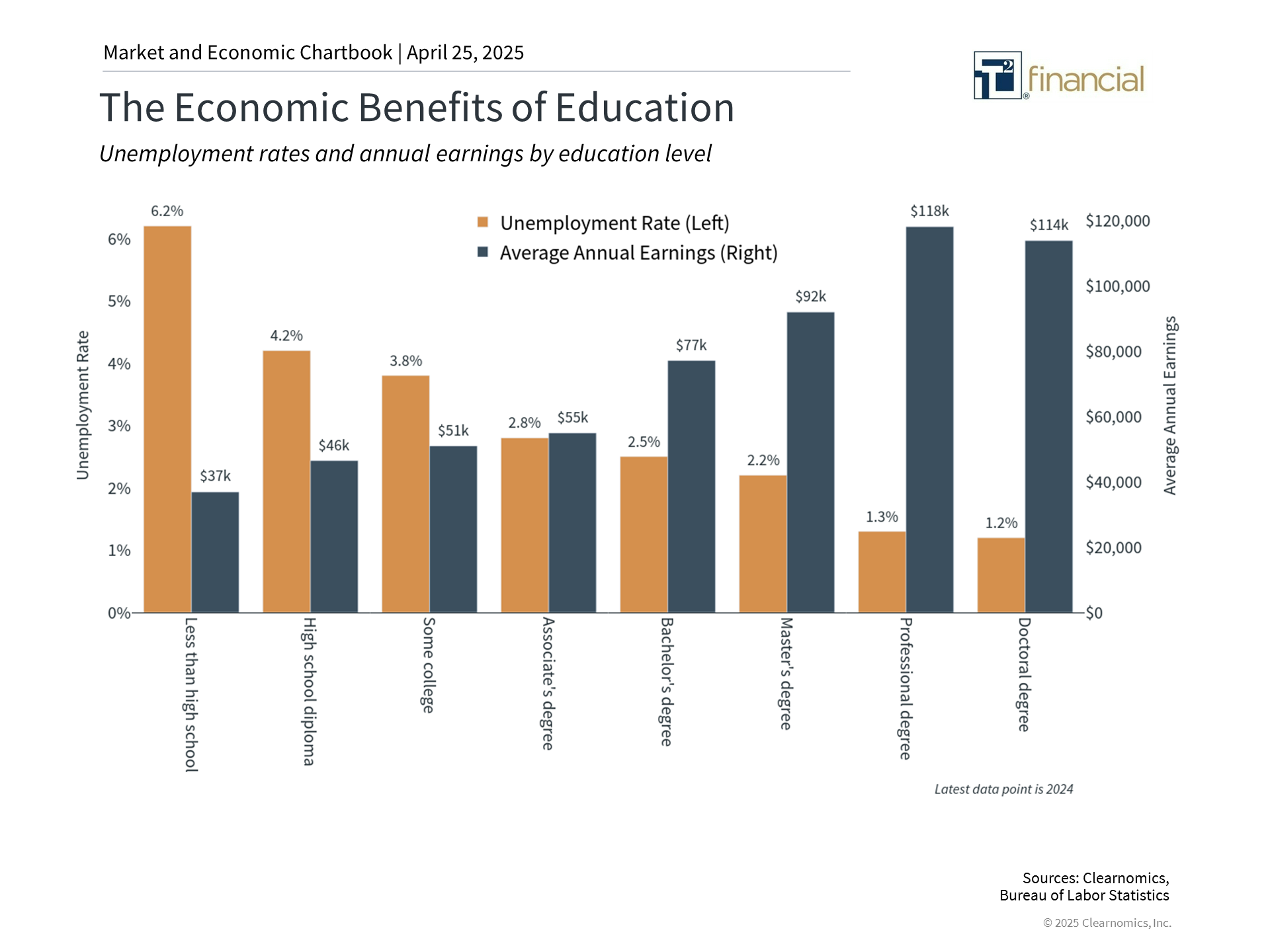
When thinking about education, it's helpful to separate the price of college from the value it gives you. College has gotten much more expensive over time. However, research shows that higher education still offers major lifetime advantages. Since these benefits vary depending on which school you attend and what subject you study, careful planning is important. College costs have grown faster than regular inflation for the past 40 years. According to the College Board, the average cost for the 2024-2025 school year reached $58,600 per year for private four-year colleges and $24,920 for public universities for in-state students (both numbers include housing and food). This rapid price increase comes from several factors: less state money for public universities, more campus features, higher administrative costs, and investments in technology. Since the pandemic, these trends have sped up with spending on hybrid learning options and campus health measures. In today's political environment, there's also uncertainty about potential cuts to government education funding. Understanding these trends matters for all families planning for college, whether your child is entering soon or years from now. Generally, starting to save earlier allows for better planning and might reduce the need for student loans that can follow graduates for many years after finishing school. Some students wonder if college is still worth the money. While it depends on individual circumstances, data consistently shows that higher education continues to provide significant money advantages. According to recent figures from the Bureau of Labor Statistics, the unemployment rate for people with a bachelor's degree was just 2.5% in 2024, compared to 4.2% for those with only a high school diploma. Similarly, average yearly earnings for college graduates reached $77,150, much higher than the $46,500 for high school graduates. For those with master's, professional, and doctoral degrees, unemployment rates are even lower and yearly earnings are higher. These earnings differences add up over a lifetime as college graduates earn more throughout their careers. Different college majors can lead to very different career earnings
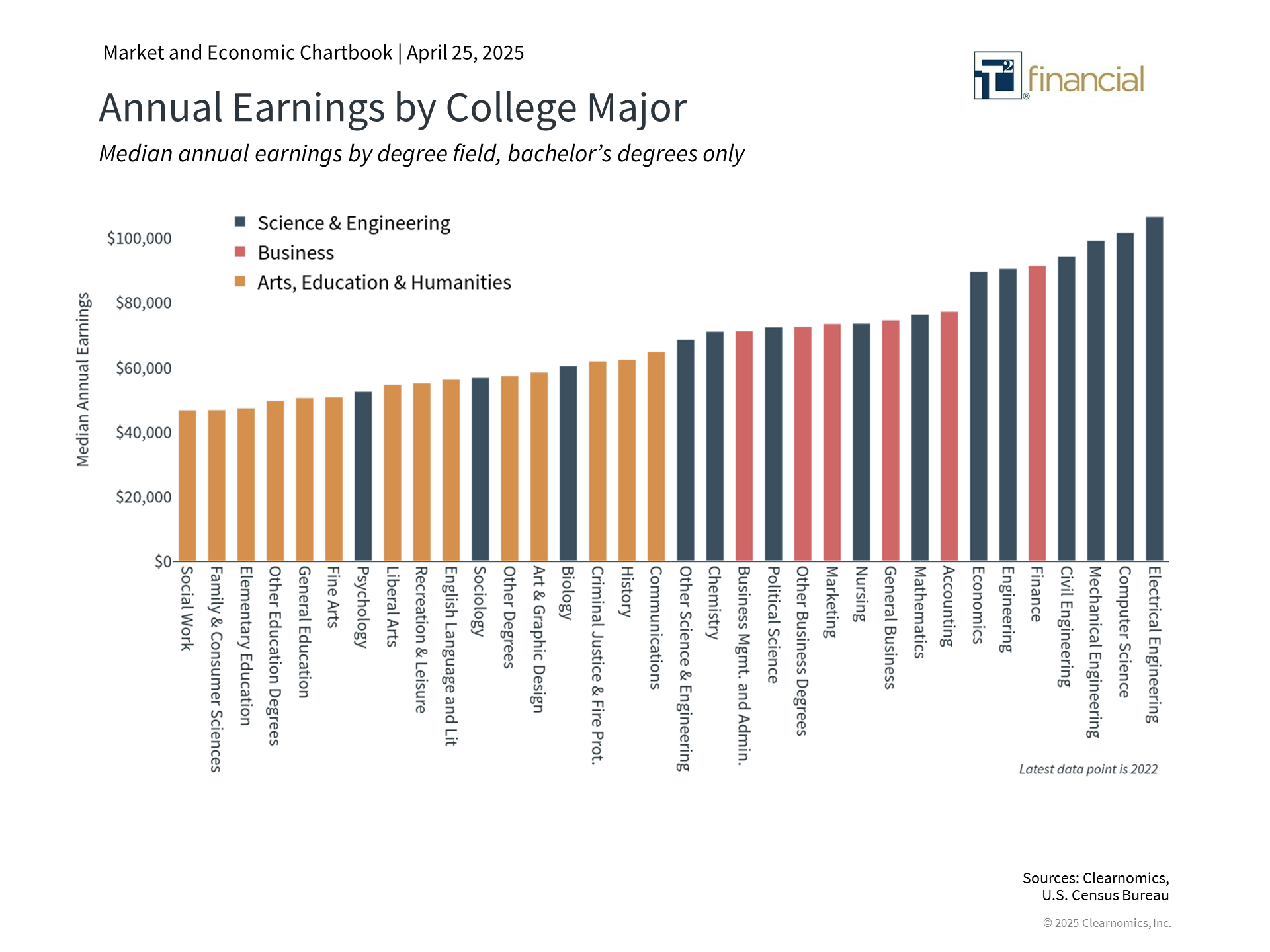
While these numbers are impressive, they don't tell the whole story since results can vary greatly based on what subject you study, which school you attend, and how well you use your education to build career opportunities. When looking at the financial return on education, your choice of major plays a crucial role. The chart shows median yearly earnings for professionals between ages 25 and 64 with bachelor's degrees. STEM fields (Science, Technology, Engineering, and Mathematics) consistently show the strongest returns, with some fields showing median yearly earnings over $100,000. Engineering and computer science majors lead in earning potential, while healthcare and business fields also show strong returns. On the other hand, fields in the humanities and education typically offer lower median earnings. Of course, higher education provides many benefits beyond just money, and graduates can take many different career paths with these degrees. These numbers don't make these fields less important but highlight the need for careful financial planning when pursuing these paths. Alternative education options are worth considering too. Technical certifications, two-year associate degrees, and apprenticeship programs can offer focused skill development at lower costs, sometimes with job outcomes similar to or better than some four-year degrees. These options may be practical alternatives for some students or complement traditional degree programs. Education savings tools and strategies provide planning options Ideally, planning how to pay for college happens long before you know what kind of education your child, grandchild, or other family member will want. But even for those close to college acceptance, using the right savings tools and strategies can help. 529 plans are the foundation of most education funding strategies. These are special accounts that offer tax-free growth and withdrawals when used for qualified education expenses. Recent law changes have made them more flexible, allowing limited transfers to retirement accounts and use for apprenticeship programs and student loan repayments. Many states also offer tax deductions or credits for contributions, making them more attractive. UGMA/UTMA accounts (which stand for "Uniform Gifts/Transfers to Minors Act") provide alternatives that allow more flexibility in how the money can eventually be used. While they don't have the tax advantages of 529 plans, these accounts allow greater flexibility in how assets are used while removing substantial assets from taxable estates (meaning potential tax savings for wealthy families). For families with enough money, direct tuition payments to educational institutions can offer a powerful exception to gift tax limits. This is because payments made directly to schools for tuition expenses are exempt from gift taxes, regardless of the amount. This special provision in the tax code allows grandparents or other family members to contribute significantly to a loved one's education without using any portion of their lifetime gift and estate tax exemption or annual gift tax exclusion. Other approaches, such as specialized trust structures, can help too. For instance, education trusts give donors more control over how money is used for college costs. You can set up rules about grades, choice of schools, or even extend benefits to future generations. These trusts can also help reduce taxes while supporting your family's education values. It's important to connect any college savings plan with your overall financial plan. Tax rules for education savings change over time, so staying up-to-date is critical. Working with a financial advisor can help you make the best choices for your family's education goals in the current environment. The bottom line? College planning requires balancing today's costs against tomorrow's benefits. By starting early and choosing the right savings tools and strategies, families can make choices that support future educational and financial success. | ||
Investment Advisor Representatives conducting business as TSquared Financial offer investment advisory services through LPL Financial, a Registered Investment Advisor. TSquared Financial is a separate business not affiliated with LPL Financial. Securities offered through LPL Financial (LPL), member FINRA/SIPC. Copyright (c) 2025 Clearnomics, Inc. All rights reserved. The information contained herein has been obtained from sources believed to be reliable, but is not necessarily complete and its accuracy cannot be guaranteed. No representation or warranty, express or implied, is made as to the fairness, accuracy, completeness, or correctness of the information and opinions contained herein. The views and the other information provided are subject to change without notice. All reports posted on or via www.clearnomics.com or any affiliated websites, applications, or services are issued without regard to the specific investment objectives, financial situation, or particular needs of any specific recipient and are not to be construed as a solicitation or an offer to buy or sell any securities or related financial instruments. Past performance is not necessarily a guide to future results. Company fundamentals and earnings may be mentioned occasionally, but should not be construed as a recommendation to buy, sell, or hold the company's stock. Predictions, forecasts, and estimates for any and all markets should not be construed as recommendations to buy, sell, or hold any security--including mutual funds, futures contracts, and exchange traded funds, or any similar instruments. The text, images, and other materials contained or displayed in this report are proprietary to Clearnomics, Inc. and constitute valuable intellectual property. All unauthorized reproduction or other use of material from Clearnomics, Inc. shall be deemed willful infringement(s) of this copyright and other proprietary and intellectual property rights, including but not limited to, rights of privacy. Clearnomics, Inc. expressly reserves all rights in connection with its intellectual property, including without limitation the right to block the transfer of its products and services and/or to track usage thereof, through electronic tracking technology, and all other lawful means, now known or hereafter devised. Clearnomics, Inc. reserves the right, without further notice, to pursue to the fullest extent allowed by the law any and all criminal and civil remedies for the violation of its rights. |
College Planning: What You Need to Know About Money